
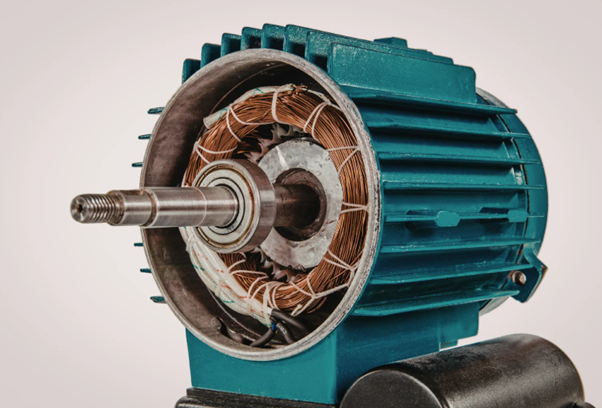
Whatever industry you’re in there’s an exceedingly high chance motors are an integral part of it. From pumps and compressors to fans and production machinery they provide the mechanical power that keeps processes going. Think commercial dough mixers in bakeries, robotic arms on car assembly lines and industrial sewing machines, just a few of the scenarios where motors are essential.

Because they operate continuously and often in demanding environments, understanding how electric motors work and how to maintain them properly is essential for keeping your equipment reliable and your operations running smoothly.
When an electric motor fails, it can disrupt your production and lead to unexpected and costly downtime. Yet, in many cases, these failures are preventable with the right approach to electric motor maintenance.
Electric Motors And How They Work
At the heart of it, an electric motor converts electrical energy into mechanical motion. This mechanical motion is what allows industrial equipment to rotate, pump, move or compress materials. Inside the motor are two key components: the stator and the rotor. The stator is the stationary outer section that contains coils of wire. When electrical current flows through these coils, it generates a magnetic field.
This magnetic field interacts with the rotor, which sits inside the stator and is free to rotate. As the magnetic fields interact, they create rotational force, causing the rotor to spin continuously. This rotation is transferred to the connected equipment, providing the mechanical power required to drive machinery.
Although this process may appear simple, it involves complex electromagnetic forces and precise mechanical movement. Motors must operate within carefully controlled limits to ensure efficiency, reliability and safe performance.
Why Electric Motors Generate Heat And Stress
As a result of several factors electric motors naturally generate heat and mechanical stress even during normal operation. Electrical losses occur when energy is converted into magnetic fields and mechanical movement and some of this energy is inevitably lost as heat. At the same time, friction within bearings and rotating components produces additional heat.
Magnetic forces inside the motor also create mechanical loads that act on internal parts. Over time, these forces can contribute to wear and fatigue in bearings, windings and insulation systems.
If this heat and stress are properly managed through good design and effective maintenance, the motor will operate reliably for many years. However, when these conditions are not controlled, deterioration can occur much more quickly.
The Operational Impact Of Motor Failure
Electric motors are rightly described as the workhorse of many important industrial processes. When one fails, the equipment it drives stops instantly, creating a domino effect on your production line.
For some organisations, this might mean only part of your production is halted but for many more it can stop production entirely. In the worst-case scenario, the resulting disruption can affect your entire facility leading to missed production deadlines and spoilage in the case of food manufacturers. Beyond the operational disruption, motor failures also create significant financial consequences. Emergency repairs, equipment replacement and lost production time can quickly become expensive.
If that’s not enough to worry about, in some situations, secondary damage may occur if connected systems are affected by the sudden loss of mechanical power. All of this makes preventing motor failure a priority for any maintenance department.
Why Poor Maintenance Leads To Motor Failure
Poor or insufficient maintenance is a common cause of electric motor failure with inadequate lubrication one of the most common causes of bearing breakdown. If you’re not regularly inspecting and servicing your motors with the replacement of worn parts or the right lubrication you can expect an increase in friction and wear and tear which leads to premature breakages.
Cooling problems can also cause serious issues. If ventilation paths become blocked by dust or debris, heat cannot dissipate effectively, and internal temperatures begin to rise. Contamination is another frequent problem in industrial environments. Dirt, moisture and chemicals can enter the motor and damage internal components, including insulation systems and bearings.
Mechanical misalignment between the motor and the equipment it drives can also increase vibration and stress. Over time, this accelerates wear and increases the likelihood of failure.
Electrical imbalance, voltage fluctuations and overload conditions may also contribute to overheating and insulation breakdown.
How Predictive Maintenance Helps Prevent Failure?
One of the most effective ways to avoid unexpected motor breakdowns is through a predictive maintenance strategy. Rather than relying solely on routine maintenance schedules, predictive maintenance uses condition monitoring techniques to assess the actual health of equipment. By tracking indicators such as vibration levels, temperature changes and electrical performance, you can identify developing faults early on.
By identifying these warning signs early, your maintenance teams can intervene before serious damage occurs. This approach allows maintenance to be planned at a convenient time rather than reacting to sudden failures. The result is less disruption, lower repair costs and greater confidence in the reliability of your equipment.
Supporting Long-Term Motor Reliability
Understanding electric motors and how they work helps highlight why proper maintenance is so important. These machines are robust and capable of operating for many years, but only when they are kept within their designed operating conditions. To learn more about how we can help you with your electric motor maintenance, please Contact us for more information.
Image Source (URL): Canva